Funding
Ontario Construction Grants & Funding 2026
Most contractors lose funding on sequencing, not on eligibility. This handbook maps the programs a Canadian construction business can actually reach in 2026, the labour conditions attached to the federal clean-technology credit, and the order the money has to be assembled in. Free PDF, no signup.
Direct answer
AEC Benefits is an Ontario group benefits brokerage for construction employers, and we publish this handbook free because the 2026 funding rules now reach directly into payroll and benefits. Canadian construction businesses can access capital through three routes that combine on the same project: direct capital grants from provincial and federal programs, the 30% refundable Clean Technology investment tax credit, and concessional long-term financing. The credit is the piece most contractors underuse, and it carries two on-site labour conditions that are audited on documentation rather than intent.
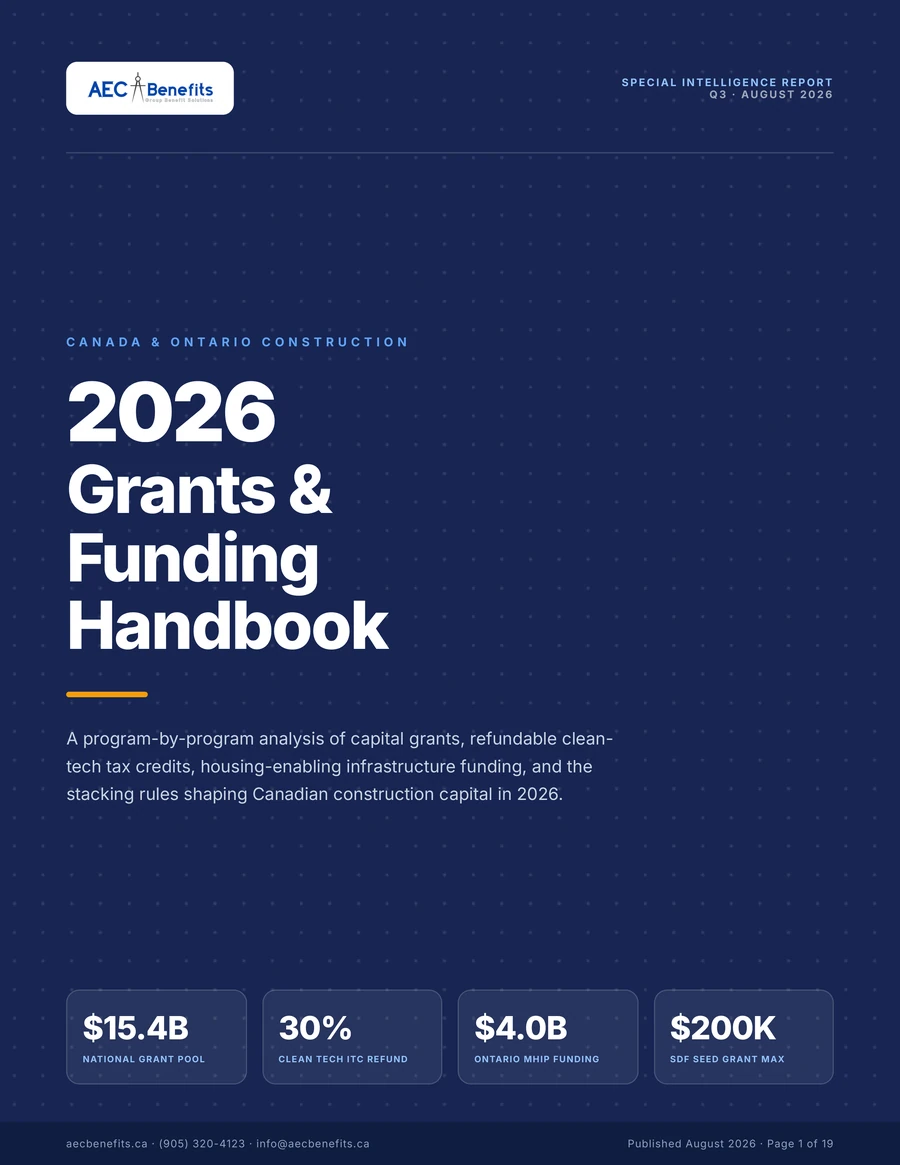
30%
refundable Clean Tech ITC
A cash refund from CRA on qualifying clean technology property, paid whether or not tax is owing.
10%
Red Seal hours by apprentices
To claim the full 30% credit, claimants must make reasonable efforts to have registered apprentices work at least 10% of Red Seal trade hours.
$200K
SDF SEED design grant cap
Ontario funds up to 70% of the design work needed to reach 40% completion on a trade training facility. GROW then funds up to 49% of the build.
2034
final year of the ITC
The credit runs at 30% through 2033 and drops to 15% for property available for use in 2034.
What you will get from this resource
- •The programs moving construction dollars in Ontario in 2026, with current status (open, closed, upcoming)
- •The 30% refundable Clean Technology ITC: what qualifies, how it's claimed, and the labour election
- •What actually happens if a job falls short of the labour rules
- •Why your benefits plan now belongs in your funding file (page 13)
- •A realistic $5M retrofit stack a private owner can put together
- •New for 2026: the Build Communities Strong Fund, the $8.8B Canada-Ontario Partnership, and the $1B MHIP stream opening Oct 29
- •2026 meal and mileage allowance benchmarks for travelling crews
- •A full sources page, with every figure traced to the body that runs the program
Why a benefits brokerage published a grants handbook
Because of one line buried in the federal rules. To claim the full 30% Clean Technology credit, a contractor has to pay covered workers a prevailing wage — and the definition of prevailing wage includes benefit contributions, not just the hourly rate. That puts a group benefits plan inside a tax credit calculation, which is not where most people expect to find it. We are not grant consultants and we do not file these claims. We publish this because the compliance side of it lands on payroll and benefits, and that part we do know.
- Prevailing wage is measured on wages (excluding overtime) plus benefits, not base rate alone
- It applies to union and non-union crews alike
- The apprenticeship condition is a reasonable-efforts test tied to workforce planning
- Falling short after electing in means wage top-ups and penalties, so the documentation matters
The three routes, and why they are not alternatives
Contractors tend to treat funding as a search problem — find the one program that fits. In practice the three routes are designed to sit on top of each other. Direct capital grants reduce the eligible cost base. The refundable ITC is a tax measure that applies on top of the remaining cost. Concessional financing sits underneath both as cheap long-term debt. A project that only chases one of the three usually leaves the other two on the table.
- Direct grants: provincial and federal capital programs, non-repayable
- Refundable ITCs: a cash credit from CRA, claimed when the property is available for use
- Concessional debt: long-term financing at below-market rates
- Combined federal, provincial, and municipal direct funding is capped by each agreement
Design readiness carries real weight
Design readiness matters across most capital programs in the handbook, and for one of them it's a hard rule. Ontario's SDF GROW stream requires 40% design at application. That's why the small SEED grant matters more than its size suggests: it funds up to 70% of the engineering and architectural work to get there, capped at $200,000. It turns an idea into a file a reviewer can accept.
What this handbook will not do
It will not tell you whether your specific project qualifies. Program values, caps, and intake windows change without notice, and eligibility turns on details no handbook can see from the outside. Treat it as a map of what exists and how the pieces fit together, then confirm current terms with the administering body before you model anything. Every program in it links back to the body that runs it.
Decision Signals
Use these signals to decide whether the next step is a quote, a renewal audit, or a deeper plan-design review.
| Situation | Signal | Next Move |
|---|---|---|
| You are installing solar, storage, heat pumps, or zero-emission equipment | The Clean Technology ITC is refundable, so it pays cash even in a loss year | Confirm the property qualifies and decide on the labour requirements election before construction starts |
| You are planning a trade training or apprenticeship facility | Design readiness scores heavier than project size across capital programs | Fund the design work through the SDF SEED pathway before submitting a capital request |
| You already have one grant approved | Grants, refundable credits, and concessional debt are designed to combine | Check the stacking ceiling in each agreement before assuming the next source is available |
| You are bidding work on an ITC-eligible project | Prevailing wage compliance is measured on wages plus benefit contributions | Price the benefits side into the bid, write monthly attestations into sub-contracts, and see page 13 of the handbook |
Content pillar
Read this alongside
This page is one piece of a larger cluster. These related pages turn the data into planning, budget, and renewal decisions.
The 30% Clean Technology ITC
What qualifies, why refundable matters more than deductible, and when the credit is claimed.
ITC labour requirements
The prevailing wage and apprenticeship conditions, and why benefits contributions count.
How grant stacking works
The ceiling, the net capital cost formula, and why a grant and a credit are taxed differently.
SDF Capital: SEED and GROW
Ontario’s two-step pathway for funding a skilled trades training facility.
AI & technology funding
Assessment grants, custom build funding, and refundable R&D credits for technology adoption.
2026 Compensation Report
Wage, benefits, and payroll burden benchmarks for Ontario construction employers.
Construction benefits hub
Plan design for Ontario contractors, trades employers, and mixed office-field teams.
Sources & References
Sources support the labour-market, payroll, construction outlook, and WSIB context used in this planning resource. Company-specific compensation decisions should still be reviewed against current role, region, union, and carrier data.
Related Pages
Frequently Asked Questions
Is the handbook really free, with no email signup?
Yes. The PDF downloads directly from this page with no form and no email required. Share it with anyone who would find it useful.
Does AEC Benefits write grant applications or administer funding?
No. AEC Benefits is a group benefits brokerage, not a grant consultancy, and we do not file, administer, or approve funding applications. We publish this handbook because the labour conditions attached to the federal clean-technology credit are measured partly on benefit contributions, which is our area. For the application itself, work with the administering body or a specialist grant advisor.
Why is a group benefits broker writing about tax credits?
Because the prevailing wage requirement attached to the Clean Technology ITC is calculated on wages and benefits together, not on the hourly rate alone. A contractor comparing their compensation against a collective agreement rate has to account for the benefits side, and that comparison is where the credit is won or lost.
How current are the figures in the handbook?
Version 2 was fact-checked on September 23, 2026 against the administering bodies listed on the sources page. Page 3 lists what changed since the August edition. Program values, caps and intake windows change without notice, so confirm current terms with the administering body before relying on any figure for a real application.
Which programs matter most for a smaller contractor?
For most Ontario contractors under 50 employees the realistic entry points are the Clean Technology ITC on equipment purchases and the technology adoption streams, rather than the large municipal infrastructure programs. The infrastructure funds are applied for by municipalities, and contractors participate through servicing agreements and joint submissions.
Reviewed by Steffen deGraaf
Steffen brings 20+ years in insurance and group benefits, construction job-site roots, and architectural technology training at Mohawk College. FSRA-regulated insurance broker specializing in Ontario group benefits.
Ontario Insurance
Want help turning this resource into action?
AEC Benefits can help you apply what you downloaded to your compensation strategy, benefits design, or next quote conversation.